
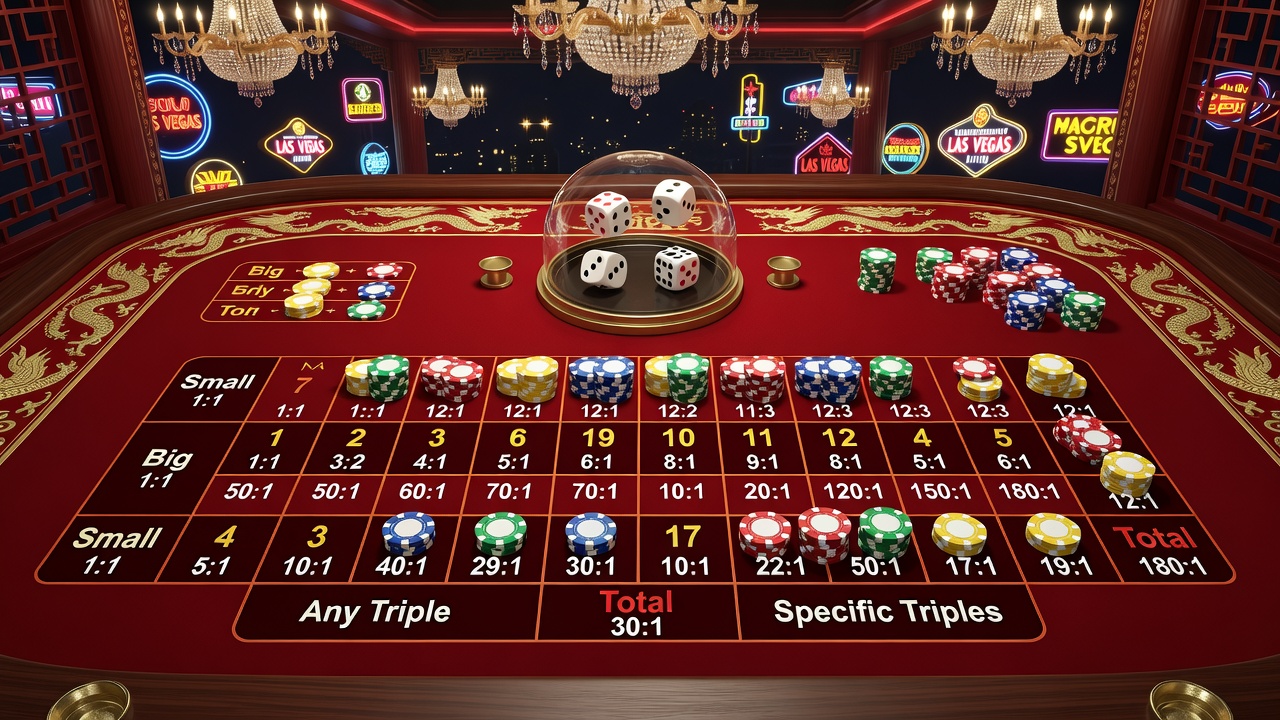
Three dice, a shaking mechanism, and payout odds that swing from even money to two hundred to one - that combination has kept Sic Bo alive on casino floors for centuries. What began as a folk dice game in ancient China now sits alongside baccarat and roulette in casinos across Macau, Las Vegas, and dozens of online platforms, yet most new players approach the felt table with no idea why some bets pay 1:1 and others pay 180:1.
That gap in odds is not arbitrary. It reflects probability, and understanding it separates players who bet on instinct from those who bet with intent. Anyone serious about mastering Sic Bo rules should start by reading the actual table layout before placing chips, and resources like sic bo rules break down exactly how each betting zone corresponds to a specific dice outcome. Once you see the logic behind the numbers, the game stops looking like guesswork and starts looking like a structured probability exercise.
This piece walks through the full mechanics: how the game is set up, how to place bets, how payouts are calculated, and which dice combinations carry the best and worst odds. By the end, you will know exactly what you are risking every time you place a chip on the table.
What Is Sic Bo and Where Does It Come From
Origins and Cultural Roots
Sic Bo traces back to ancient China, where it was played with painted stones or blocks before dice became standardized. The name translates roughly to "precious dice" or "hi-lo," a nod to the two most basic wagers a player can make. Chinese immigrants carried the game to Southeast Asia and eventually to Western casinos in the 20th century, where it was adapted to fit standard table gaming formats without losing its core structure.
How It Fits Into Modern Casino Gaming
Today, Sic Bo occupies a niche similar to craps: it is a dice game driven entirely by chance, with no skill-based decision-making beyond bet selection. Unlike blackjack or poker, there is no card counting, no bluffing, and no way to influence the outcome once the dice are shaken. That simplicity is precisely why it appeals to players who want fast rounds and transparent odds rather than prolonged strategic play.
Physical vs Online Versions
Physical Sic Bo uses a dealer-operated shaking device, often a mechanical cage, to randomize three dice inside a sealed dome. Online and live-dealer versions replicate this with either a digital random number generator or a live-streamed physical shaker. The betting layout and payout ratios remain identical across both formats, so learning the game once applies universally, whether you are at a Macau table or playing through a mobile app.
Sic Bo Rules: The Foundation of the Game
Table Layout and Betting Grid
A standard Sic Bo table displays a grid marking every possible bet: individual numbers, specific pairs, total sums, and combination bets. Each zone on the layout corresponds to a fixed payout ratio, printed directly on the felt so players can verify odds before betting. This transparency is a defining feature of Sic Bo rules - there is no hidden house edge calculation required, since the payout for each bet type is displayed openly.
Number of Dice and Shaking Process
Three six-sided dice determine every outcome. The dealer or automated device shakes them inside a covered container, then reveals the result once all bets are locked in. No betting is allowed after the shake begins, which keeps the process fair and prevents any advantage from timing.
Betting Rounds and Table Limits
Each round is independent. Players place chips on one or multiple betting zones simultaneously, and there is no requirement to bet on every round or maintain a running wager like in blackjack. Table limits vary by casino, typically with a minimum per bet type and a maximum aggregate limit across all zones a player occupies. Knowing these limits before sitting down prevents mid-game surprises, especially at higher-stakes tables where minimums can be steep.
How to Play Sic Bo Step by Step
Placing Your First Bet
Learning how to play Sic Bo starts with chip placement. Select a betting zone on the layout - this could be a single number, a specific total, or a combination - and place your chips directly on that section before the dealer calls "no more bets." Multiple bets on different zones are allowed within the same round, letting players hedge or diversify their exposure.
Reading the Dice Outcome
Once the dice settle, the dealer reveals the three values and marks all winning zones on the layout. Payouts are distributed automatically according to the fixed odds for each bet type. Losing bets are cleared, and the table resets for the next round within seconds.
Common Mistakes New Players Make
New players frequently spread chips across too many zones, diluting any potential payout and increasing the house edge exposure simultaneously. Another frequent error is betting heavily on specific triple combinations without understanding how rare those outcomes actually are. A disciplined approach - sticking to a handful of well-understood bets - produces more consistent results than scattershot betting across the entire grid.
- Confirm your bet is placed correctly before the dealer closes betting
- Track which zones pay even money versus long-shot odds
- Avoid chasing losses by increasing bets on high-risk combinations
Sic Bo Betting Rules and Bet Types
Small and Big Bets
The most straightforward wagers in Sic Bo betting rules are Small and Big. A Small bet wins if the total of the three dice falls between 4 and 10, while Big wins on totals between 11 and 17. Both pay even money, but neither wins if the roll produces a triple - a rule that pushes the house edge slightly in the casino's favor.
Single Number Bets
Players can bet on any single number from 1 to 6 appearing on at least one of the three dice. The payout scales with how many dice show that number: one match pays 1:1, two matches pay 2:1, and three matches pay 3:1. This bet offers a reasonable balance between frequency of winning and payout size.
Combination and Total Bets
Combination bets require two specific numbers to appear together among the three dice, regardless of the third value. Total bets, by contrast, wager on the exact sum of all three dice, ranging from 4 to 17. These carry significantly higher payouts because the probability of hitting an exact sum is much lower than hitting a broad range like Big or Small.
Double and Triple Bets
A Double bet wins if two of the three dice show a chosen number, while a Triple bet requires all three dice to match. Triples are the rarest outcome on the table, and betting on a Specific Triple - where you predict the exact number repeated three times - carries the steepest odds and the highest reward.
Sic Bo Payout Rules by Dice Combination
Understanding Payout Ratios
Every bet type in Sic Bo comes with a fixed payout ratio determined by the mathematical probability of that outcome occurring. Sic Bo payout rules are printed directly on the table layout, and casinos rarely deviate from standard ratios since the game's appeal relies on predictable, verifiable odds. Small and Big bets pay 1:1, single number bets scale from 1:1 to 3:1, and specific totals or triples can pay anywhere from 6:1 up to 180:1 depending on the venue.
Why Rare Combinations Pay More
With three dice, there are 216 possible outcomes in total. A Specific Triple - say, three 4s - occurs in only one of those 216 combinations, which is why its payout dwarfs that of a Small or Big bet, where roughly half of all outcomes qualify as winners. This inverse relationship between probability and payout is the mathematical backbone of the entire game.
House Edge Across Bet Types
The house edge in Sic Bo is not uniform across all bets. Small and Big carry a relatively low edge, often cited around 2.78%, making them the most statistically favorable choices for cautious players. Specific Triple bets, despite their massive payout, carry a house edge that can climb above 30%, since the true odds of hitting them are far worse than the payout compensates for.
- Small/Big: even-money payout, lowest house edge
- Single Number: payout scales with matches, moderate edge
- Any Triple: pays around 30:1, high edge
- Specific Triple: pays up to 180:1, highest edge
Sic Bo Dice Combinations and Probability
Calculating the Odds Behind Each Bet
Because three dice are rolled simultaneously, calculating Sic Bo dice combinations requires accounting for every permutation, not just the visible face values. For example, a total of 10 or 11 can be formed through more individual dice combinations than a total of 4 or 17, which is why totals near the middle of the range pay less than totals at the extremes - they occur more frequently.
Why Extreme Totals Are Rarer
A total of 4 can only be formed by the combination 1-1-2, while a total of 10 can be formed by numerous combinations including 1-4-5, 2-3-5, and 3-3-4. This mathematical reality means totals clustered around 10 and 11 are statistically the most common outcomes, and betting on them without recognizing their higher payout-to-frequency mismatch can lead to poor value decisions.
Practical Implications for Betting Strategy
Recognizing which dice combinations occur most often allows players to weigh risk more accurately. A total bet on 10 or 11 pays less than a bet on 4 or 17 precisely because it wins more frequently - the payout structure compensates for probability, not for excitement. Players who understand this relationship tend to build steadier, more sustainable betting patterns rather than chasing the flashiest payout on the board.
Frequently Asked Questions
Is Sic Bo purely a game of chance, or does strategy matter?
Sic Bo is entirely chance-driven once the dice are shaken, but strategy still matters in bet selection. Choosing bets with a lower house edge, like Small, Big, or single numbers, gives you better long-term value than chasing high-payout triples.
What is the safest bet to place in Sic Bo?
Small and Big bets are generally considered the safest, carrying close to even-money payouts and a house edge under 3%. They win on roughly half of all possible dice outcomes, excluding triples.
Can I place multiple bets in a single round?
Yes, players can place chips on several betting zones simultaneously within the same round. This allows for diversified exposure, though spreading bets too thin across many zones can reduce overall payout efficiency.
Why do specific triple bets pay so much more than other bets?
A Specific Triple occurs in only one out of 216 possible dice combinations, making it the rarest outcome on the table. The payout, often as high as 180:1, reflects that extremely low probability.
Do online and physical Sic Bo tables use different payout rules?
The core payout ratios remain consistent between physical and online versions, since they are based on fixed mathematical probabilities. Minor variations can exist between individual casinos, so checking the posted table layout before betting is always worthwhile.
How many dice are used and how are results determined?
Sic Bo uses three six-sided dice, shaken either mechanically or digitally depending on the format. The combined values of all three dice determine every winning and losing bet on the table for that round.